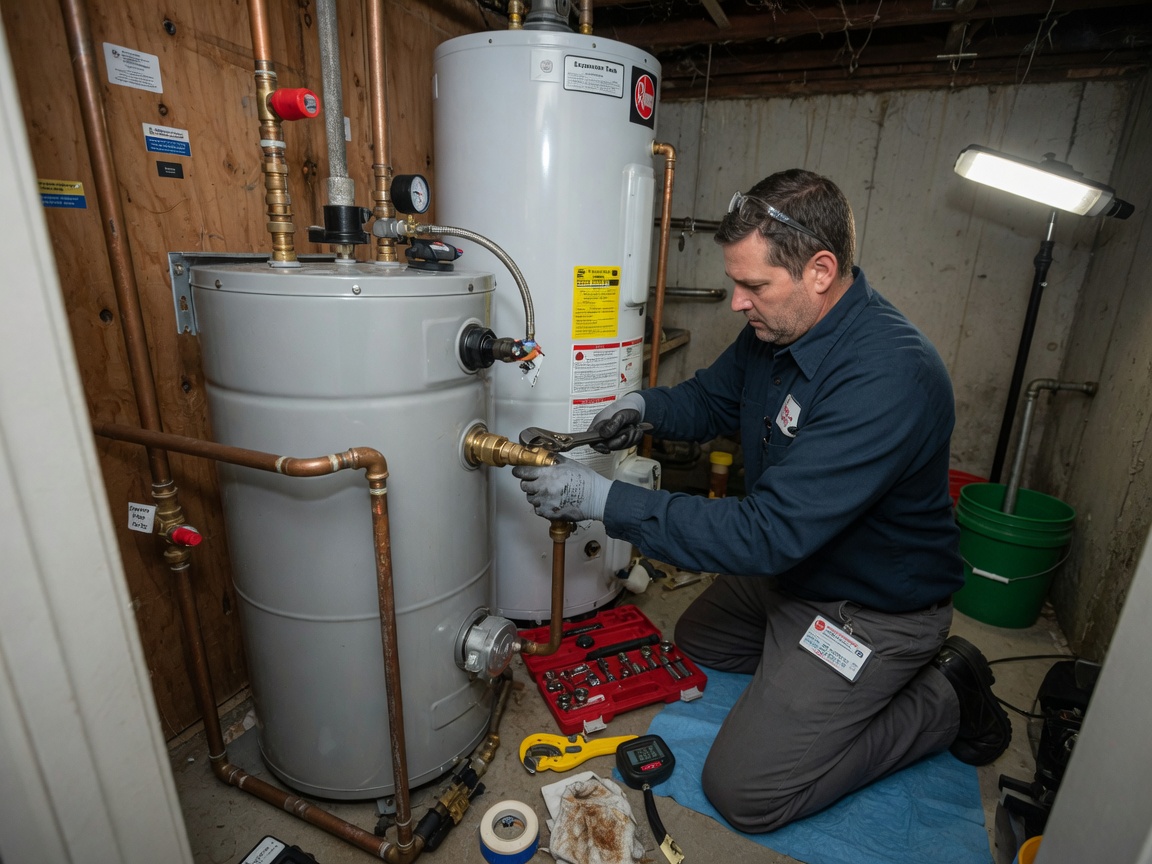
Bothell homes in Westhill and Maywood often feature 1970s–1990s construction with copper or early PEX lines that create closed systems once backflow preventers were added countywide. Thermal expansion from daily 40-degree swings in mild wet winters pushes pressure past 80 psi, stressing older tanks and T&P valves. We measure static pressure at the meter, check for diaphragm failure by listening for water hammer near North Creek Forest properties, and replace tanks with 4.5- or 8-gallon models sized to the heater gallonage rather than guessing.
In North Creek and around the UW Bothell Campus, newer tract homes from the 2000s frequently have 50- or 80-gallon electric units paired with undersized expansion tanks that were never recharged after the initial fill. Sediment from the Snohomish-King County transition water can clog the tank nipple within five years. Our techs isolate the heater, drain to the expansion tank only, test the Schrader valve under 40 psi air charge, and reinstall with dielectric unions to prevent galvanic corrosion common on these lots.
Downtown Bothell and nearby Kenmore streets sit on glacial till that holds moisture, so garages and crawlspaces stay damp even in dry summers. This accelerates rust on steel expansion tanks mounted low. We recommend stainless or composite tanks on any replacement and always verify the cold-water line shutoff is accessible before starting, because many 1980s homes in the area buried valves behind finished walls.
Technician insight
In Bothell's Westhill homes with 1980s copper, the thing that catches most people out with water heater expansion tank repair is the buried cold-water shutoff behind drywall—homeowners think the job will be quick until we have to open the wall, and wet winters keep those walls damp so we always check for mold before closing up.
North Creek townhome pressure spike
A 2008 townhome near North Creek Forest showed 92 psi at the meter after the city replaced the meter setter. The original 4.5-gallon tank had a ruptured diaphragm and was waterlogged. We isolated the heater, replaced the tank with an 8-gallon model, set the charge to 58 psi, and confirmed pressure now peaks at 68 psi during recovery.
Water Heater Expansion Tank Repair Services We Offer
✓Expansion Tank Replacement
Remove failed tank, install correctly sized replacement with new dielectric unions and fresh air charge matched to local water pressure.
✓Diaphragm Recharge and Testing
Check and restore factory air charge on existing tanks, test for leaks, and confirm the tank is still separating water and air properly.
✓System Pressure Regulation Check
Measure inlet pressure at the meter and adjust or recommend a whole-house regulator when expansion tank alone cannot keep pressure under 80 psi.
✓Expansion Tank Installation on New Heaters
Mount and pipe a new expansion tank during water heater replacement to meet King County closed-system requirements.
✓Leak Repair at Tank Connections
Replace corroded nipples, unions, and shutoff valves that commonly leak where expansion tanks connect to older copper lines in Westhill homes.
Water Heater Expansion Tank Repair Cost in Bothell, WA
| Service | Typical Range | What Affects It |
|---|---|---|
| Expansion tank replacement | $275–$475 | Varies by tank size and whether new shutoff or unions are needed |
| Diaphragm recharge and test | $95–$165 | Lower when tank is accessible; higher in tight crawlspaces common in Maywood |
| Full system pressure regulation visit | $150–$250 | Includes meter reading and regulator adjustment if required |
| New expansion tank with heater install | $185–$325 | Added to heater replacement; price depends on 4.5 vs 8 gallon model |
Ranges are typical for Bothell, WA and confirmed with an exact written quote before any work starts.
How it works
- 1
Pressure And Location Assessment
We arrive at the Bothell address, record static pressure, locate the tank, and note pipe material and heater age.
- 2
Isolation And Drain
Shut off cold water, relieve pressure, and drain only the expansion tank to avoid full heater drain on most jobs.
- 3
Component Replacement Or Recharge
Swap the tank or recharge the diaphragm, install new unions, and restore the correct air charge.
- 4
Re-Test And Documentation
Turn water back on, verify no leaks, confirm pressure stays within range, and leave written notes for the homeowner.
Pricing
Upfront quote given after we measure pressure and inspect the existing tank on site.